Sunday, 14 July 2013

Indoor attraction for rainy days

I finally made it to the Sunshine City Aquarium! I have been talking for years to visit this aquarium, but I never make myself here until today and this is to avoid the typhoon that has been whipping up Tokyo right now.

Back to Sunshine City Aquarium, no doubt, it has some pretty cool display, but it is also small and crowded during the school holidays. I can't help but to feel bullied by parents with babies who acted that their babies have the birthright to get the best view, regardless if they rolled their prams on you or poke you with their big baby bag or shove you with their elbow with babies on their hips. As a result, I stayed on the sides of the aquarium where it is less crowded. But the pictures are so worth it!


I think it is best to avoid the Japanese school holidays as it will be so crowded with families. The ticket lines are long and the walking space in the aquarium is very narrow. It is hardly a time to enjoy this place (I should have heed the warning sign of long queue outside the ticket booth). But I think at other times, it should be pleasant to visit.


Pretty cool display


It is like another world out there


Minus the crowd factor, some of the displays in the aquarium were pretty cool and I love to visit the Sunshine City Aquarium again in a less crowded opportunity. 

Visiting this place also made me want to visit Singapore's South East Asia Aquarium again. It has been years since my last visit and I heard that it is better now with a petting tank.

How did you spend your rainy day today?

Sunday, 5 May 2013

Cascading beauty

Don't you ever wished that some movie scenes can be real? Walking in the wisteria garden of a certain flower park reminded me of one such scene. The good thing is you can actually experience this same magic as I did at the Ashikaga Flower Park in Tochigi-ken. The garden is located in the city of Ashikaga, which is appromimately 70mins train ride from Tokyo. To get there. take the Ryomo Express Train (特急りょうもう号) from Asakusa (浅草) to Ashikaga-shi (足利市) on Tobu Isesaki Line (東武伊勢崎線). From the station, you can catch the shuttle bus to get to the flower park.


Like something out of a fairy tale or some sci-fi fantasy movie, this tree is really captivating. I am immediately and totally mesmerized by this tree. Especially at night, after the tree is being lighted up, the wisteria tree with its cascading blooms becomes surreal and makes anyone felt like they are under the illuminating Tree of Souls in the movie, Avatar.

See? It's really the Tree of Souls!!!
The wisteria tree has several different color of blooms; white, pink, purple and even yellow. Generally, the wisteria tree flowers from mid-April to mid-May.


I can't get enough pictures of this beautiful blooms that creates this ethereal atmosphere. One walk around the tree and you will understand why this tree is such a magical place for its viewers.


This park also has wisteria trees lined perfectly in rows, and its overwhelming abundance of flowers makes one feel like they are in paradise. Did I mentioned the fragrance of these flowers? Heavenly!


I bet a walk through the wisteria tunnel is enough to make you forget all your troubles.


Isn’t this just absolutely breathtakingly beautiful?


Friday, 8 February 2013

Sweet fragrance of winter in Chichibu Nagatoro

Last winter after a particularly hard week of research which leaves me muddled-head and gasping for fresh air, I chanced upon an interesting pamphlet which featured a rather curious blossom. I have never seen this flower before and the photo featured in the pamphlet was a well-taken photo featuring a line of strange pale yellow blossoms on a sunny day. And a good photo is all it took to convince me to hop onto the train and go for it.

To see these pale yellow blossoms, I have to take the train to Chichibu Nagatoro (秩父長瀞) in Hodosan Roubai-en (宝登山ロウバイ園), Saitama. These blossoms are roubai (ロウバイ) or also called as the wintersweet. The shrub usually flowers in the winter after the New Year. According to Wikipedia, they are also called as the 'ice flower' which sounds cool to me.


Just to let you know that it is relatively easy to get to Nagatoro from Ikebukuro. From Ikebukuro (池袋), take the Seibu-Ikebukuro Line (西武池袋線) on the Rapid train(特急)to Seibu-Chichibu station (西武秩父). From Seibu-Chichibu station, change to Chichibu Railway (秩父鉄道) and take the train heading towards Hanyu (羽生) to Nagatoro station. This whole journey takes about one hour and 40mins.

From the Nagatoro station, it is a short walk of 15mins to Hodo-san and then, you have a choice to take the ropeway or a good one hour hike to the top. The ropeway costs 480yen for one trip and 820yen for return trip and you can find the timetable for the ropeway here (in Japanese).

From Nagatoro Ropeway website
If you go during the blooming time of the wintersweet, you should easily find your way from the Nagatoro station as there will be signboard posted all the way. If not, you can easily follow the crowd ^^ and you will not be lost.

Mid-way through the hike, I stop for a while to nurse my hunger (just an excuse to taste the local tonjiru), then, I finally reach the yellow blossoms.


And to my surprise, these flowers are fragrant! They are beautiful and fragrant! How lovely!!! This is a flowering shrub that you shouldn't miss in winter.


The  Hodo-san temple on top of the hill
It is a nice place to have picnic lunch. There are some small stores selling food like tonjiru, sweet sake (amazake) and dango near the temple grounds if you didn't bring any food with you.

Yes, I want to have a relaxing lunch all the time like this
After my 2nd bowl of comforting tonjiru, I relax in front of the fire with some amazake
So, will you be visiting a wintersweet garden the next winter? 


Tuesday, 31 July 2012

Giant glories at the Hono Asagao-ten, Yasukuni Shrine

This is a post that I meant to post long time ago. Sorry that it didn't match the timing of the post. The photos are a mix of old and recently taken. 

I love waking up early to go for my walks, especially in the summer. So one fine (hot!) day, I woke and went to the Yasukuni Jinja for a potted morning glories exhibition or as they called it, Asagao-ten (朝顔展). As the morning glories wilted under the hot sun, the exhibition usually starts early at 6am which is great for me as I can go and then come back in time for my work. 

morning-glory-exhibition

The morning glory plant is a popular household plant since the olden times in Japan for two reasons. The plant provides shade that cools the hot summer air and the flower provides beautiful blooms that pleases the eye. If the cherry blossom symbolizes spring, then "asagao" or the morning glory is the flower that symbolizes summer.  
Asagao-exhibition

And every summer in Japan, we are treated to several morning glory fairs around Tokyo. While these fairs are intended as a place for you to buy the plants, the exhibitions are to make the cultivation of the morning glory plant and its knowledge more widely known among the general public

This is my first time visiting a potted plant exhibition in Japan and it is a 'WOW' exhibition for me. I wasn't prepared for the surprise in discovering so many varieties of bloom size, shape and colour for such a simple plant. I have learned that the cultivation of the Japanese morning glory plant is a serious business, but it is also considered a unique one in the history of horticulture. 

Introduced from China for more than a thousand years ago, the flower, asagao, which can be literally translated as the 'morning face' in the Japanese language, has enjoyed a long cherished presence in Japan ever since its introduction. The morning glory plant was used as a medicinal plant during the Nara period. Later on, during the Edo period, it has been used as an ornamental plant.

The cultivation of the morning glory started in the late Edo period. Since then, the morning glory plant has experienced a number of periodical booms, especially during the Bunka and Bunsei eras (1804-1830), the Kaei and Ansei eras (1848-1860) and well into the Meiji and Taisho eras (1868-1926). After the Meiji-Taisho period, the popularity of the mutation techniques dwindles and gave way to the large-blossomed morning glories which you can view them at this exhibition.

This is the 39th time the Yasukuni Shrine has held their giant morning glory exhibition, Hono Asagao-ten, and exhibited these uniquely cultivated large-blossomed morning glory plants. You can see the morning glories in their full bloom under the shade exhibition stand. 

 Hono-Asagao-ten

Yasukuni-Shrine

Yasukuni-Shrine

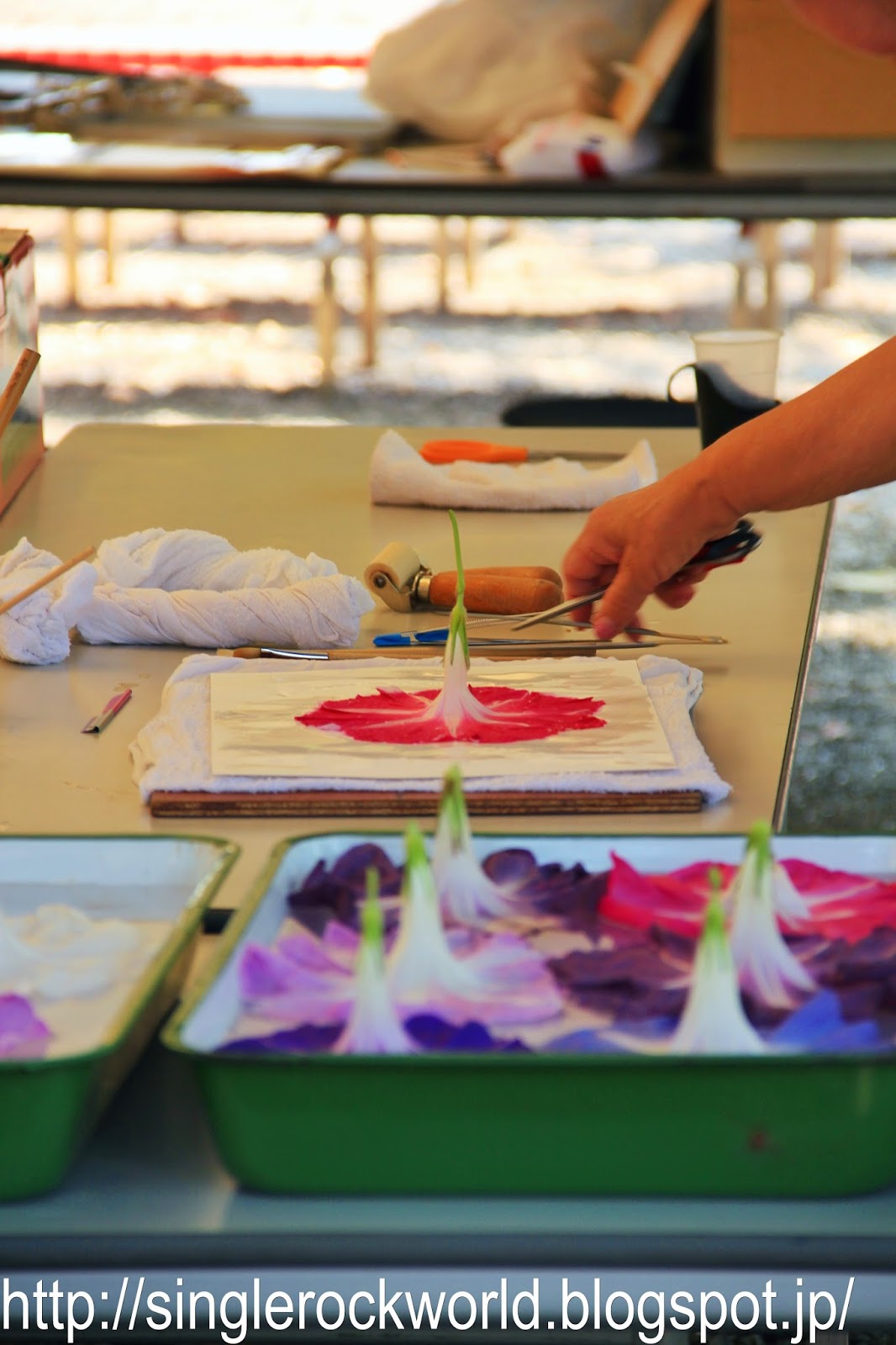
Apart from learning about the morning glory plant, there is a class where you can also try your hands in making your own pressed morning glory print. Actually, it is a class meant for children, but if they are not too busy, you can try it. I didn't after learning that I have to wait for an hour or two to dry the pressed morning glory print. Need to get back to work before that.

Hibiya-Park

Yasukuni-Shrine

Yasukuni-Shrine

Morning-Glory

The potted morning glories exhibition at Yasukuni Shrine will still on display from now until Aug 7th 2012. 

Access: Kudanshita Station accessible by the Tozai, Hanzomon or Toei Shinjuku Subway Line.

*Update: The morning glory exhibition is on display from now until Aug 3rd 2014.

Hono-Asagao-ten

Yasukuni-Shrine

Yasukuni-Jinja

Wednesday, 4 April 2012

Japan's traditional hot spring: Kusatsu

Finally, managed to go to one of Japan's oldest hot spring. The hot spring experience was one of the best ones I've tried, but the town is really small with not much activities to do. My arm was hurting and a dip in hot spring made it go away. Really good waters!!

There are few recommended transportation from Tokyo  to Kusatsu. We took the highway bus instead of the train because it is much less of a hassle. To get to Kusatsu take 3.75 hours by bus. If you are plan early enough, JR Kanto Highway Bus offer the cheapest ticket of ¥2,500 instead of the normal fare of ¥3,200. Bookings have to be as early as one month ahead.

We took the Spa Resort Liner for 2,000yen but they have additional charges for holidays and holidays eve so this is a good deal if you are not traveling peak season. They also have other destinations.

The hotels that we stayed in are:
Kindai Pension
〒377-1711 群馬県吾妻郡草津町草津542-5
電話:0279-88-7788
FAX:0279-88-8660
It was this hotel that I took a bath in one of their hot springs, the lava rock bath (溶岩洞窟風呂) cured the pain in my arm. You can also see the mineral particles collecting around the bathtub. Genuine stuffs, I'd say. It was a wonderful bath. The beds have the fluffiest blanket, perfect for winter, but a bit hot after sleeping in it for a while. And we love the sofa the best! They served western dining style which was delicious. The only lament is the check-out time at 10am... Too early for us to hit the road, especially after such a nice breakfast.

湯宿 季の庭
〒377-1711 群馬県吾妻郡草津町大字草津464-214
This hotel has all the trained service and hospitality, but I think the hot spring waters somehow didn't work as well as Kindai Pension. But they served the best beef shabu-shabu! The meat's so soft that it just melted into your mouth! Overall, I think the stay was enjoyable too.

Maybe it is better to stay 2 nights at each hotel to enjoy the place and its ambiance rather than changing hotels every day. Some wonderful memories during our visit to Kusatsu.

Kusatsu town

monkey
草津熱帯園

草津西の河原公園
Related Posts Plugin for WordPress, Blogger...