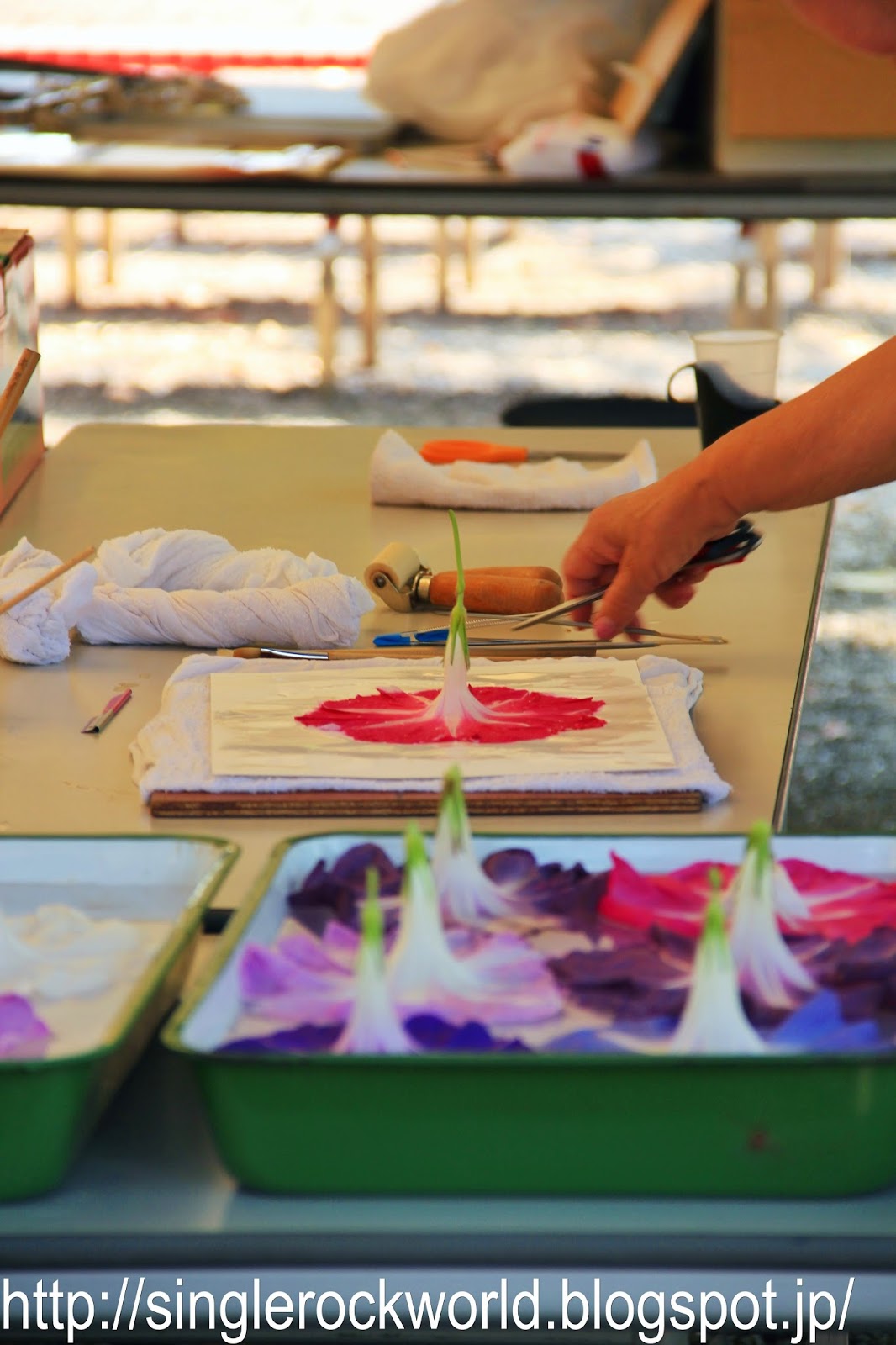
I know most of my readers knows me by now that I am in love with flowers. I remembered when I was young, I couldn't resist not picking flower whenever I see one. I would one flower to put behind one of my ears and another one for the other ear. When the flowers wilted, I will pick another one. Yes, that action, sometimes got me into trouble. Well, that was all good memories for me ^^ Not so much to those I caused the distress to...
m(_ _
)m
So, talking about flowers, I am off to another special exhibition of morning glory plants in the Hibiya Park organized by the Tokyo Morning Glory Research Association. The association has 40 years history in researching, propagating and creating new morning glory hybrids and at the same time, preserving the mutated seed of morning glories. This is their 64th exhibition - yea!
 |
| When you reach Hibiya Park, you will see this poster (I forgot about taking a photo of this year's poster so I used my last year's photo). |
Similar exhibition can also be seen at the
Yasukuni Jinja but this one is better! I will tell you why, but first, a bit on the history of the cultivation of morning glory plants in Japan (I found new information and wanted to share it although it may be boring stuff to you - sumimasen).
The cultivation started in the late Edo period when these cultivators experimented on the natural mutation of the morning glory seed and found new ways to create new types of leaves and flowers in the morning glory plants. And after that, the morning glory plant experienced a boost in its popularity well into the Meiji-Taisho period until after that, the morning glory plant of natural mutation gave way to the cultivated hybrids of large-blossomed morning glory plant. Due to the loss of interest, much knowledge of these plants been lost.
However, due to the efforts of a small group of enthusiastic cultivators, some of the earlier naturally mutated plants managed to survive. From them, we now know how the cultivators back in those days grew the naturally mutated hybrids of the morning glory plant. Now, these techniques and the cultivation using a selected mutation of morning glory are maintained with an adaptation of a more advanced method of cultivation and the knowledge of our present-day genetics.
Thanks to the efforts of these small growers, today, we can see these naturally mutated hybrids and the large-blossomed morning glories here in this annual exhibition at the Hibiya Park. This is why this exhibition is better than the one in Yasukuni Shrine.
 |
| Poor morning glory out in the sun |
Among the differences you will notice between the two kinds of Japanese morning glories, is the size and colour in the blooms. The latter cultivation of the Japanese morning glory plants has resulted in bigger blooms with a variety of colours. The blooms of a Japanese morning glory span between 15sm wide, but some can have larger blooms than others and some have frilly blooms.
The blooms have also cool physic-referenced names such as "speckled" (blooms with dots on them), "rayed" (blooms with a line of white trim on the edges of a bloom) and "blizzard" (blooms with two swirling colours). The colour of the morning glories ranges from the muddy rose colour to the dark blue colour.
Where else, the blooms of the naturally mutated hybrids are usually small, and some plants don't even look like anything close to a morning glory plant. Some plants are so unique that you swear you have never seen a morning glory before until these.
 |
| Yes, this is a morning glory |
 |
| This one too |
 |
| I think this one is called falling star |
 |
| These all looked like ikebana to me |
After the blooms, the next difference you may notice is their distinctive foliage. The cultivation of the leaves of the Japanese morning glory plants has resulted in various leaf forms. One of the more popular leaf forms in both kinds is called the "tonbo-ba" (トンボ葉) and it is supposedly resembled a dragonfly spreading its wings (Sorry, I didn't get any photos for the "tonbo-ba"). A dragonfly is called "tonbo" in Japanese.
There are also other leaf forms in the naturally mutated kind too, such as the Maple leaf, the willow leaf (Yanagi-ba), the Bamboo leaf and these are just some leaf forms that I learned from the cultivators. The leaves also come in coloured variegated types too, usually a green variegated leaf (Ao-Fuiri-ba) or a yellow variegated leaf (Ki-Fuiri-ba).
 |
| The green variegated leaves kind |
 |
| The yellow variegated leaves morning glory |
Well, you can see both kinds of the morning glories at this exhibition. It will be on display in the area near the tennis court.
This exhibition is not only to display new hybrid of morning glories, it is also a competition for its association members to show off their prize-winning plant. You can meet with the morning glory creator, talk to them, learn about the morning glory plant and even buy the plant from them.
The exhibition starts from 8am till 11am from now until 3rd Aug 2014.
Access: Hibiya Station accessible by the Metro Chiyoda line, Metro Hibiya line or Toei Mita lines. The nearest exits are Exit A10 or Exit A14.
I think this exhibition is a good opportunity for me to wake up early. How about you?