Showing posts with label Festival. Show all posts

Sunday, 10 August 2014

Summer festivals: The dance of the gods

Last week, I went exploring a relatively low-key neighbourhood, Oji to catch a traditional performance called Dengaku at the Oji Shrine. Dengaku is a type of folk dance involving music and spiritual dance associated with the rice production. 


In the past, the dengaku was performed as a prayer for an abundance of the crop. While the main idea of dengaku dance is a dance performed with the movement that is related to agricultural activities such as sowing the seed, planting the seed or chasing the birds that eats the crop, for the Oji Shrine Dengaku, it is considered to be a form of kagura dance. The Kagura dances are sacred dances that are performed with the intention to channel the deities into the human form. 

Therefore, the Oji Shrine Dengaku dance is performed with the movement that suggest the actions of the descended deity. Each step performed by the performers purifies the ground and it is believed that this will encourage a good crop for the year after. 

The performance usually starts with a process of purification around the area where the Dengaku will be performed. And then, the performance will start with the arrival of important guests. 


an-ensemble-of-important-guests

During the performance, two heavily armoured warriors to keep the evil spirits away during the performance. 

I really love the armour


This warrior has paddy stalks with him


The performers are usually young children around the age between 8-10. Young children were chosen because in the past, young children was believed to be the perfect intermediary between the spirit world and the human world. During the performance the children's faces are hidden under the elaborately decorated hat (花笠-hanagasa). In the background, you can hear the combination music of the flute and drum. 


After the deities departed, the shrine representatives will introduce the children to the audience. I was kind of surprised to see how young some of them are - one was only 6. When the crowd cheered, you can see their faces beaming with big smiles. 

After the deities departed


After the introduction of the young performancers, the representatives of the nearby neighbourhoods will distribute packets of goodies to the audience. The crowd goes back with a happy face and a bag of goodies. I got myself a bag too. Not bad for a day's venture. 

Distributing Summer goodies


The Dengaku was popular in Kamakura period (1185-1333) However, the Dengaku dance was once lost after 1944, but was revived in 1983 by the efforts of one person, Mr Honda. Today, the Oji Shrine Dengaku is considered to be an intangible cultural asset of Kita ward because the level of accuracy of today's portrayal to the original way of performing the Dengaku

Every year, we can watch this traditional folk dance at the Oji Shrine on the first Sunday of August at 4:30pm and lasted usually an hour. Unlike some performances, the Dengaku dance is actually quite entertaining. I would probaby go back next year just to watch it again. And this time, without my camera. 

So, have you been able to watch any folk dances in Japan lately?  

Thursday, 7 August 2014

Summer Festival: Flowers of Fire in Arakawa River

I have a love-hate relationship with the summer season here in Japan. For those who have never been in Japan for its summer season, let me tell you - Japan's summer is waaaaay worse than Malaysia's. It is hot (no, hot is still an understatement. I think I will call it 'oven'). It makes you sweat like waterfall. It steams you like the live prawn cooked in a pot of steaming hot water (Too bad that I don't have a picture of this dish!). Yes, I am from the near-to-the-equator-hot Malaysia and I surrender to the summer here in Japan. Total surrender.

Fortunately, I love the festivals that are happening in the summer season in Japan, especially the fireworks festival or as we call it here, Hanabi (花火). Not to be confused by Hanami (花見, which is the "flower viewing" in spring e.g. cherry blossom period), hanabi can be literally translated as flowers of fire.

Fireworks-in-Japan

The fireworks festival has a long history in Japan. History has it that in the year 1733, after a year of an epidemic and famine, Shogun Tokugawa Yoshimune, ordered a fireworks display on the Sumida River to appease the souls who died in the epidemic and to ward off the evil spirits who is thought to be behind the disasters. Later on, the fireworks display is used as an entertainment for the upper class of the society while they wine and dine on their leisurely adrift boats in the Sumida River. Soon, the fireworks display assumed an even more prominent role, which is to signal the opening of the boating season. This fireworks display naturally attracts the people of old Edo to come together around the river to enjoy the fireworks display and the coolness of the evening.

This is the reason why today the fireworks festivals are almost always held in a location near a body of water, such as a river, a lake or on a beach. Apart from being able to enjoy the cooler evening air, the body of water also provides a safe location to set off the fireworks and a wide space to accommodate the huge crowd of audience.

Nowadays, the Japanese just enjoys the fireworks as an art on its own, the ephemeral beauty of every sparkle and dazzle. And that kind of thinking has embodied in me too. For me, as much as I hate crowds, I will try to attend at least one fireworks festival every year. This year, I went to a relatively new fireworks event for me which is the Itabashi Annual Fireworks Festival on the Arakawa River. You are guaranteed to have a good view of the fireworks display as the river banks have sloping terrain which overlooks the river. The Itabashi Annual Fireworks Festival was a pretty good show, which you can watch from my video below. Although I didn't like the sloping terrain very much, but it did provide me a good view of the display.

fireworks-in-Arakawa-River

ARAKAWA-RIVER-FIREWORKS

Moreover, this is one of the festivals where you can really immerse in the real Japanese atmosphere. Everyone from the neighbourhood will turn up. Some dressed in the yukata (the traditional summer kimono). They stroll the streets that are lined with food stalls. After getting their food and drink, they spread the picnic sheet and relaxing on the river banks, drinking cold beer while fanning themselves with the uchiwa (round-shaped fans). All there to watch the fireworks display.

Special-Events

Special-Events

There are lots of firework shows are held in various cities around Tokyo between July and August. I believe this coming weekend on 10th August is the Tokyo Bay Fireworks. It is a big fireworks display starting from 6:50pm onwards for almost 1.5hours of the fireworks display. But it is also, one that draws thousands of spectators. If you want to join this fireworks festival, I suggest that you go early enough to secure a place*. You also have to note that the Rainbow Bridge will be closed to the pedestrian during the show.

For more fireworks events, you can check out this website (in English) and this one (in Japanese). The Japanese website will be able to give you more information about the event such as the number of fireworks, the nearest train stations to the event site and you can pay for the special reserved area for the event.

Among all the fireworks festival in Tokyo that I have ever been to, I enjoyed the Edogawa Fireworks Festival the best. The terrain of the river bank is flat and spread out like an empty football field. You can lie down and relax. You can also watch the sun as it sets. There are no tall buildings that will obscure your views of the fireworks display. Except for some annoying photographers with their tall tripods.

Watching fireworks go up into the sky with a big bang, burst into breathtaking lights of dazzle and slowly disappears as a rain of little shimmering sparkles is the kind of spectacle that you have to experience it for yourself at least once in your lifetime.

* Sorry, I have no advice on where and how to get a good view of this event because I avoid this one especially.

So, which fireworks event are you going to join this summer?


Japan-Festivals-August

fireworks-in-Arakawa-River

Japanese-fireworks

Tuesday, 5 August 2014

Summer Festivals: Dancing at the Fish Market (sort of)

I wanted to write this post for so long, but work was piling up so this post was delayed. Actually, I wanted to write about the Obon festival here in Japan. As you know, July and August are the season of festivals. Starting with the Tanabata festival in early July, fireworks festival in mid-July till Aug and the Obon festival in August, the whole of Japan is bursting with nights filled with traditional folk dance, food stalls and lots of dancing going around accompanied by folk music. 

As you may already know, Obon festival is a Buddhist-originated festival when the souls of their ancestor return home. The idea of death in many cultures that are influenced by Buddhism is different from the idea of death in the Western culture. In these cultures, many believe that the soul lives on even after the death of its physical being. And Obon is the time for families are supposed to pay tribute to their ancestor. This is the time you will see families doing some sombre tasks of cleaning the graves and make offerings to their ancestors. 

But the not-so-sombre moments also happen during the Obon. This is also the time when everybody gathers together to dance around a temporary yagura tower with the traditional music. Usually these festivals are held in the evening when everybody comes out to enjoy the summer evening breeze, which lends the word of noryo (納涼), which literally translated it as 'evening cool'. This word is sometimes reflected in the name of the festival such as the Tsukiji Honganji Temple Noryo Bon-Odori (築地本願寺納涼盆踊り). 

So, here I am, enjoying my evening cool time in the Tsukiji Honganji Temple, watching the Bon-Odori festival. The Tsukiji Honganji Bon Odori is known to be one of the more established Obon festivals in Tokyo. 
tsukiji-fish-market
Still empty
tsukiji-fish-market

Tsukiji-Honganji-Temple
But you can see that people are already there to book a table for the evening

From the exterior, you will notice the architectural design of Tsukiji Honganji Temple is different from the other temples in Japan. That is because Tsukiji Honganji Temple is an Indian-inspired Buddhist temple. The current building of Tsukiji Honganji Temple is rebuilt after the original one located in Asakusa got burnt down in a fire. It is also endowed with a big space which is rare for a temple in the space-starved Tokyo. I guess that is why this place is chosen to hold the Bon-Odori festival here. 

It began with drum or taiko beating session. By 4pm, the temple is literally crawling with people, this is still a small crowd. People come here earlier to reserve a seat in front of the stage. There are lots of food stalls, called the yatai, which sells usual street food such as the buttered potatoes, corn on the cob, kakigori (shaved ice with syrup), yakisoba (fried noodles) and many other delicious foods which you should try it in person. 
Bon-Odori-Matsuri

Matsuri
Strong and muscular taiko performers
tsukiji-fish-market

As the hour draws nearer to the starting time of the Bon-Odori festival at around 7pm, you can see the crowd will slowly build up. Even with the crowd, the generous space of this temple made a difference. I can still vouch on my claustrophic bones that even with the big crowd, it still manages to feel pleasant and lively at the same time. This event has a really good atmosphere compared to some of the Bon-Odori festivals I have been to. I believe the generous space of this temple made a difference and that it allows big crowd of people without feeling the squeeze. 

At 7pm, the Bon-Odori festival officially starts. A group of dancers will be up on the yagura tower, dancing to the traditional music. I guess they are there to guide the crowd on how to dance. The nicest thing about Bon-Odori festival is that ANYBODY can join in the dance! Most of the dance steps look simple enough but I did not try it. Mainly because I have my bulky DLSR with me. But I'd love to try it some time soon though. May have to leave the camera at home ^^.

Tsukiji-Honganji-Temple
The crowd before the festival starts
summer-festival

obon-dance-festival

There are plenty of tables with seats and stalls to fill your stomach. Come early if you want to find a seat with a good view of the festival. The Tsukiji Honganji Temple's Bon-Odori is spread over four evenings. 

If you have one chance to watch the Bon-Odori festival, then, you should watch it at the Tsukiji Honganji Temple. Don't forget to wear your yukata (summer kimono) for this special occasion! I promised you that you won't regret it.

If you love participating in local festivals, then, you should be in Japan for a summer. But if you are planning your trip to Japan during the Obon period, please take note that this is the time of summer vacation for the Japanese people so there is lots of travelling going around. Highways are always full. The rate of road accidents is higher than usual, causing lots of traffic jams. It is not exactly a fun time to travel. But it will worth the inconvenience. 
Tsukiji-Honganji

Tsukiji-Honganji


Date of the event (in 2014. It might be best to check the website)
July 30-August 1, 7pm-9pm; August 2, 6pm-8.30pm

How to get there
Tsukiji Hongan-ji Temple is one minute walk from the subway Tsukiji Station on Hibiya Line. Go to: exit 1for the nearest access.
Or you can walk for 5-minutes from the Shintomicho Station on Yurakucho Line, the Higashi-Ginza Station on Asakusa Line and the Tsukiji-shijyou Station on Toei Oedo Line. 

Location and Website
Address: 3-15-1 Tsukiji, Chuo-ku, Tokyo

http://tsukijihongwanji.jp/tsukiji/index_e.html (in Japanese)
http://www.tsukijihongwanji.jp/eng/?fr=navi (in English)

summer-festival
Enjoying the festival
Matsuri

Noryo-Bon-Odori-Matsuri
A young audience enthralled by the taiko drummers
Taiko-Performance
Love the colorful lanterns
Bon-Odori-Matsuri

Saturday, 2 August 2014

Summer Market: Wind-chime Festival at the Nishiarai Daishi

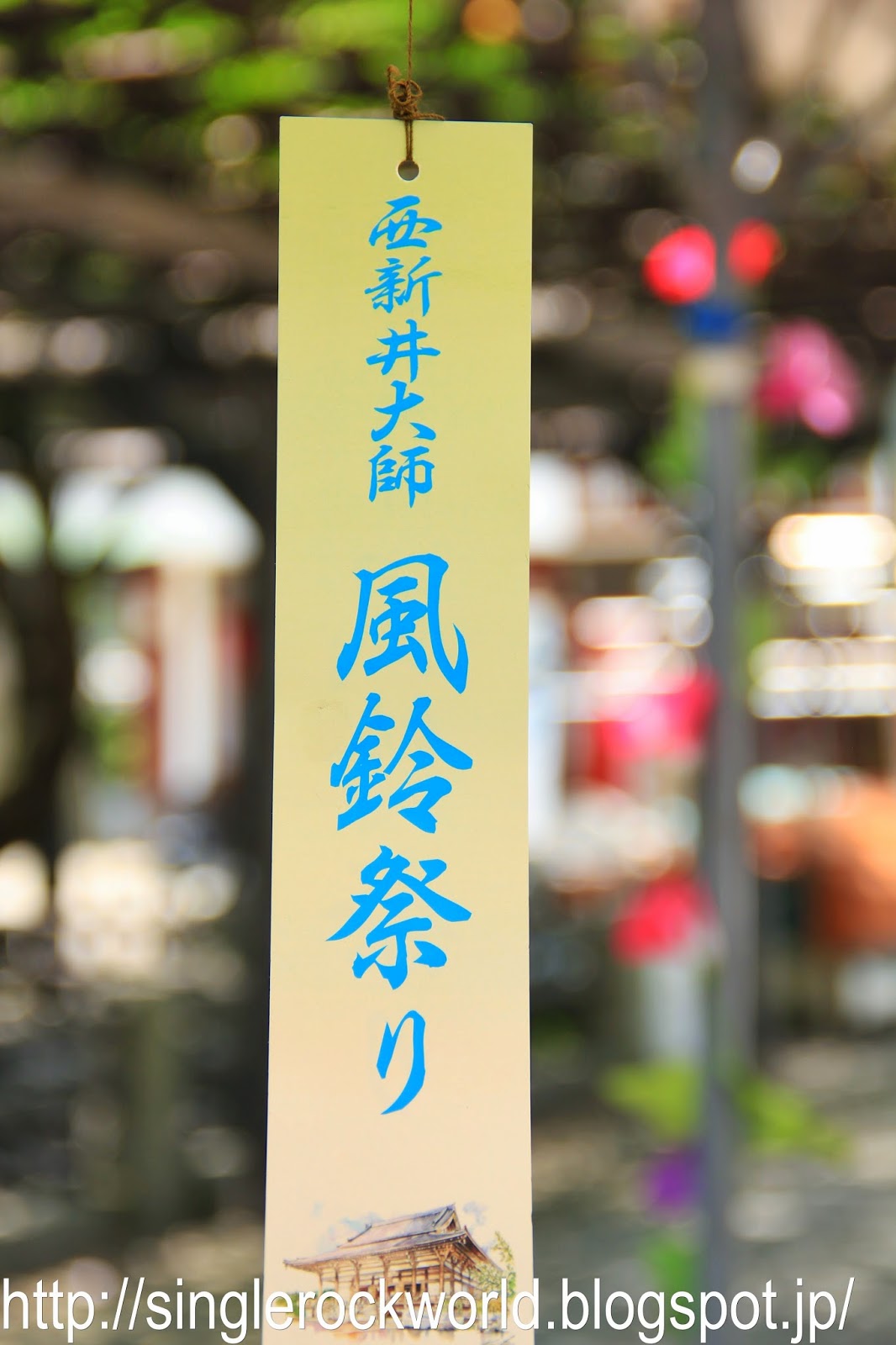
I arrived here at one of the three main 'Daishi' temples in Tokyo, Nishi-Arai Daishi, for a special festival. Although the temple's formal name is Soji-ji (總持寺), everyone calls it by its common name, Nishiarai Daishi temple (西新井大師). Actually, the common name of the temple, Nishiarai Daishi, has a story behind it.


The story goes like this - A long time ago, there was a great drought in this area. A highly respected Buddhist monk, Kōbō Daishi the Great Teacher (弘法大師) came to this area to help the suffering people. He carved out an 11-faced Kannon statue where he then knelt down to pray for 21 days, which then, a dried-out well began to fill with water again. Everybody gets their water from the well, and the drought ended.

Now, the magic well was located on the west side of the temple, thus, the name, Nishiarai, which literally stands for the West New Well (西新井) and the latter name is to honour the great Buddhist monk, Kōbō Daishi, who ended the drought.

So here I am exploring a relatively low-key festival, the wind-chime festival or also called as the fuurin matsuri (風鈴祭り) in this relatively unexplored neighbourhood.

It was a hot day and I guess not so many people wants to linger too long

In this festival, only artisan-made wind-chimes are on sale. Each and every wind-chime is made uniquely and this is the place where the artisan from all over the country will be showcasing and selling their beautiful creations. The festival exhibits a variety of colours, shapes and sounds. Here you can browse, touch and listen to the sound of the wind-chime.


Although, most of the wind-chimes are made out of glass, but there are some unique ones that are made out of metal and bamboo. The prices of the wind-chimes varies. A simple one can cost about 500yen, but some can cost more than 5,000yen.


When you have found your wind-chime, all you have to do is to write down the number of that wind-chime and take it to the temple's booth to pay. You will be given a receipt along with a carefully boxed parcel containing the wind-chime.

Although, I arrived a bit late to the festival, but I must say that I am still impressed with the collection of Japanese wind-chimes that were on display here. I believe if you arrive early, you will be able to see an even more selection of wind-chimes.


The nearest station to the Nishiarai Daishi temple is the Daishi-mae Station (大師前駅) on Daishi Line, which is an extension of the Tobu Sky Tree Line (東武スカイツリーライン, Tōbu Sukaitsurii-rain). The temple is only 5-mins walk from the station.

Big but empty station


If you started your journey from anywhere other than in the Kita-senju station (北千住駅, Kitasenju-eki), i is best to take the train on the Metro Chiyoda Line (東京地下鉄千代田線 Tōkyō Chikatetsu Chiyoda-sen) heading towards Abiko (我孫子).

Get off at the Kita-senju station, but stay on the same platform to catch the train on the Tobu Sky Tree Line to get to Nishiarai Station (西新井駅, Nishiarai-eki). The platform serves both Metro Line and Tobu Line.

Once you get to Nishiarai station, you have to get off again to change to the Daishi Line.
At Nishiarai station, waiting for the next train to Daishi-mae station

For Daishi Line


The Daishi-mae Station is on a single track rail from Nishiarai station. And you pay for your journey at the Nishiarai station not at the Daishi-mae station.

The single track line
The sign to pay your train fare at the Nishiarai station
No ticket booth
The whole journey should take about 40mins. As I boarded the train ride from Ikebukuro, the whole journey costs me about ¥390 per way.

Alternatively, you can board the Toei bus No. Oh-40-Ko (都バス - 王40甲) from the east exit of Ikebukuro station and stop at the Nishi-Arai Daishi Bus Stop (西新井大師バス停, Nishi-Arai Daishi Basu-Tei). The timetable for the bus can be found here. The whole journey is only 210yen. By bus, it takes about an hour to reach, but you get to see another view of the city which you usually can't on a train ^^.

If you are looking for an authentic wind-chime, then, this is the festival for you. Find that perfect wind-chime just for yourself at this annual festival held in the grounds of Adachi's Nishiarai Daishi temple.

My perfect fuurin


The shopping street in front of the temple
A traditional shop selling rice crackers

Related Posts Plugin for WordPress, Blogger...